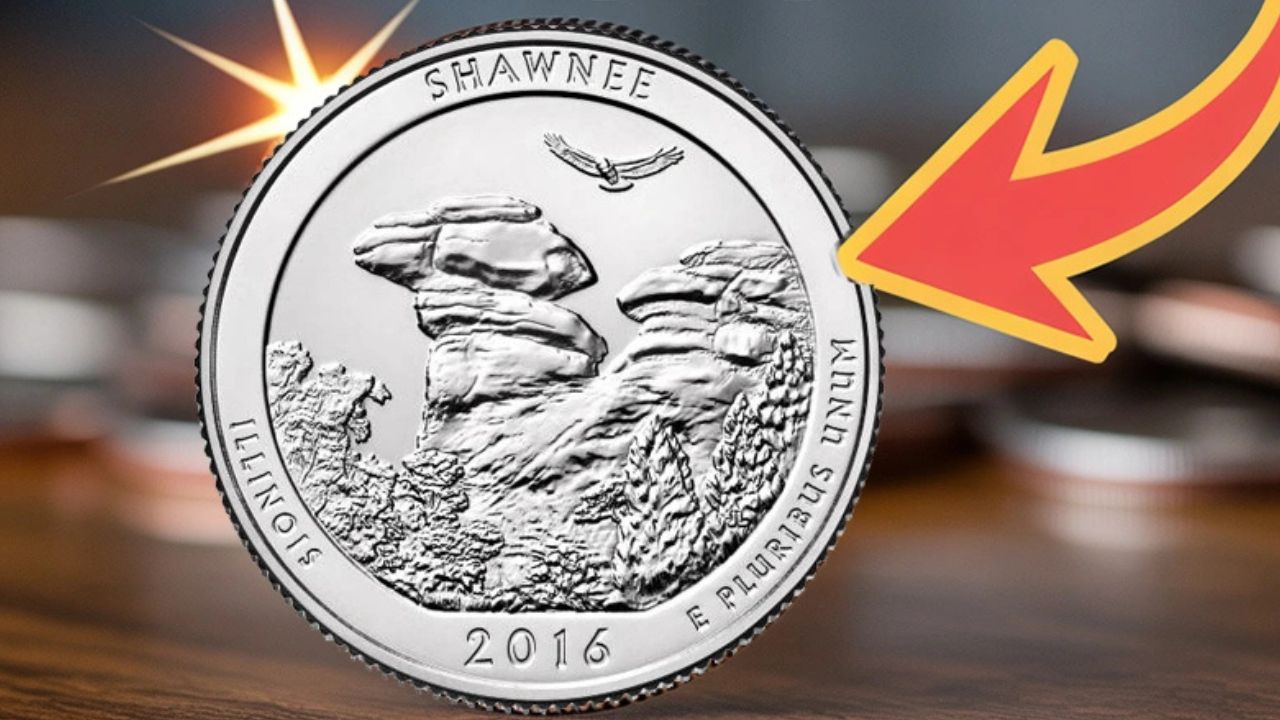
Did you know that a simple quarter in your pocket could be worth thousands of dollars? That’s exactly what happened with a 2016 Shawnee National Forest Quarter, which stunned collectors by selling for $3,800 at auction. The reason? A rare minting mistake known as a reverse cud error.
In this article, we’ll break down everything you need to know about spotting this rare coin, understanding the error, and what to do if you find one.
What Is the 2016 Shawnee Quarter?
The 2016 Shawnee National Forest Quarter is part of the U.S. Mint’s America the Beautiful series. It features the scenic Camel Rock formation located in Illinois’s Shawnee National Forest. Over 150 million of these coins were produced, making it a common quarter in circulation.
But what makes a select few of these coins worth hundreds or even thousands of dollars is a unique minting flaw — the reverse cud error.
What Is a Reverse Cud Error?
A cud error happens when a piece of the die — the metal tool that stamps the design on the coin — breaks off. When this happens, molten metal fills the missing space during striking, resulting in a raised, blobby area on the coin’s surface.
In the case of the Shawnee quarter, this error appears on the reverse (tails) side. It often shows up as a chunky, raised area near the coin’s rim — especially around the forest design or lettering like “Shawnee.” This noticeable flaw is what makes these coins so attractive to collectors.
Why Did One Sell for $3,800?
While many error coins sell for modest amounts, one Shawnee quarter with a reverse cud fetched $3,800. Why such a high price?
- Clearly Defined Error: The cud was large and easily visible, adding to its appeal.
- Mint State Condition: The coin showed minimal wear, suggesting it was never circulated or pulled quickly.
- Rarity: Reverse cud errors on this particular coin are quite rare, making it a standout among millions of regular strikes.
When a coin has both a significant error and excellent condition, its value can skyrocket.
How to Check Your Change for the Shawnee Quarter Error
You don’t need to be a professional numismatist to spot this valuable quarter. Here’s how to examine your change:
1. Look at the Reverse Side
Flip the coin and inspect the tails side. Look for any unusual raised blobs or shapes, especially along the rim.
2. Focus on the Rim
The cud often appears near the edge — around the “Shawnee” inscription or the forest imagery. Any distortion or extra metal may be a clue.
3. Use a Magnifier
A basic jeweler’s loupe or even your smartphone’s zoom function can help you spot fine details you might miss with the naked eye.
4. Compare with a Normal 2016 Shawnee Quarter
If you have a second Shawnee quarter, compare the two. Subtle differences will be easier to detect side by side.
Should You Get It Graded?
If you think you’ve found one of these error coins, consider sending it to a professional grading service like PCGS (Professional Coin Grading Service) or NGC (Numismatic Guaranty Company). Here’s why:
- Authentication: Experts can confirm if it’s a genuine cud error.
- Market Value: Certified coins often sell for much more at auction or to private collectors.
- Protection: Graded coins are sealed in tamper-proof holders for long-term preservation.
Even a minor cud in decent shape can be worth $50–$100. But coins with large, dramatic cuds in mint condition can reach into the thousands of dollars.
Final Thoughts
Finding a coin worth thousands in your spare change might sound like a dream — but it’s entirely possible. The 2016 Shawnee Quarter with a reverse cud error proves that everyday pocket change can hold hidden treasures.
So next time you’re sorting through your coins, take a closer look. That odd-looking quarter could be a $3,800 jackpot in disguise. Happy hunting!